
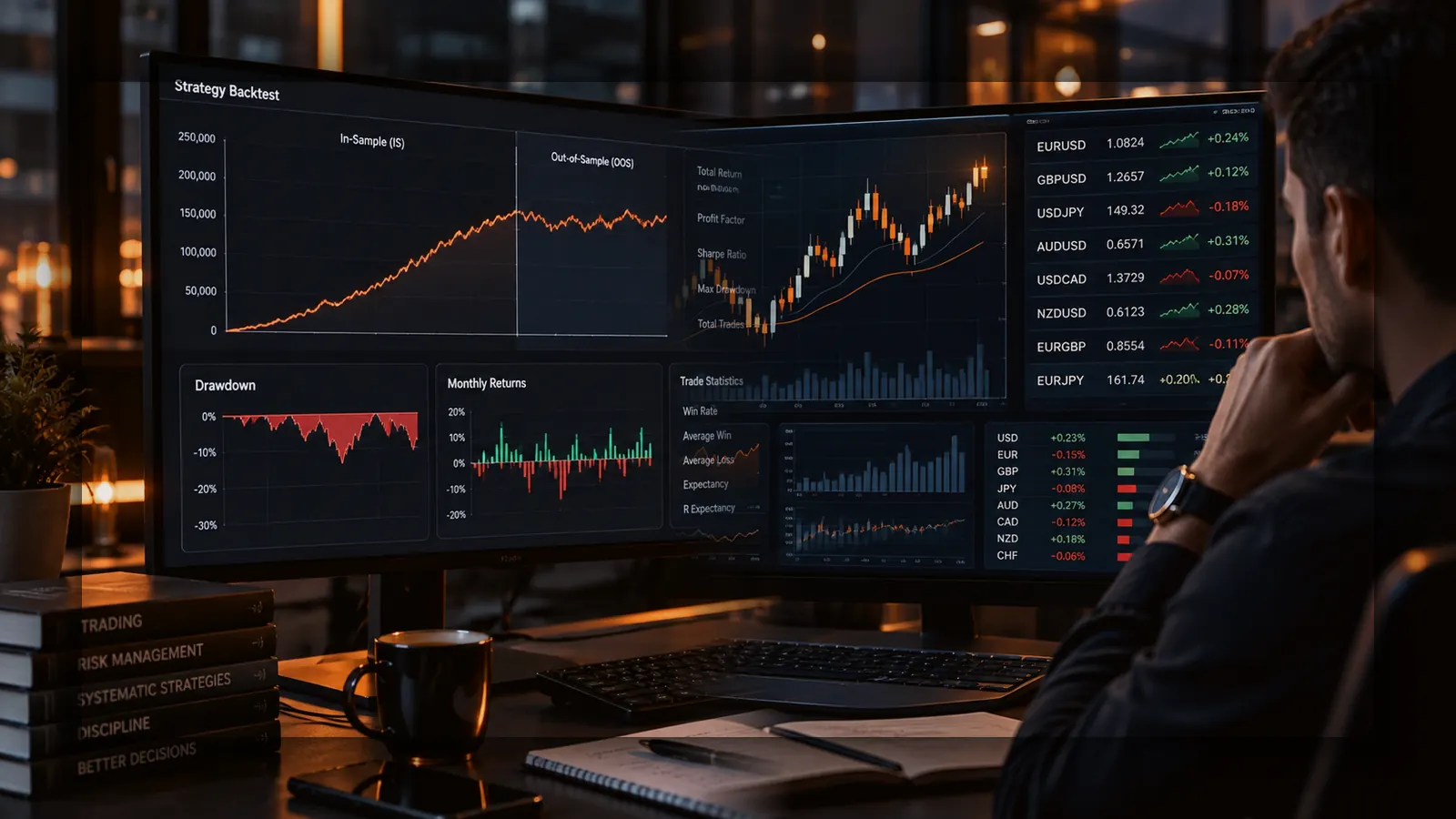
A backtest and a live account are running the same strategy logic, but they are not the same experiment. A surprising number of the differences between a strong backtest and a disappointing early live result come down not to a flaw in the strategy, but to genuine, structural differences between simulation and reality. Understanding those differences is what makes watching live behaviour worthwhile, rather than simply assuming the backtest will repeat itself.
Market conditions move on
A backtest is tested against a specific historical window. Live trading begins wherever the market happens to be at that moment, and continues into conditions the backtest never saw. If the market regime that suited the strategy has shifted — even subtly — live results can diverge from the backtest simply because the underlying conditions have changed, not because the strategy stopped working correctly.
Spread and slippage
Backtests rely on assumptions about spread and slippage that approximate live execution costs. Real spread can widen during news events or thin liquidity; real slippage depends on broker, instrument, and market conditions at the moment of execution. For a strategy with a thin edge per trade, small differences between assumed and actual execution costs can matter more than they appear to on paper.
Execution and trade timing
The exact moment an order is placed, and how quickly it fills, can differ from a backtest’s simplified execution model — particularly around fast-moving price action. A strategy that depends on precise entry timing is more exposed to this kind of difference than one with wider tolerances.
Data differences
The price data used for backtesting — its source, its granularity, occasional gaps or quality issues — is not always identical to the live price feed a broker provides. Small discrepancies here can shift exactly when a strategy’s rules trigger, even if the underlying logic is unchanged.
Market regime and sample size, again
Live trading is, in effect, a new out-of-sample test that keeps running for as long as the strategy stays live. Early live results — the first weeks or months — represent a small sample, exposed to whatever specific conditions happen to occur during that window, just as any limited backtest window is. A short stretch of live underperformance is not automatically evidence the strategy has failed, any more than a short stretch of live outperformance is proof it’s better than its backtest suggested. See Why Trade Frequency Matters When Building a Portfolio for why sample size matters in either direction.
Why this makes live monitoring genuinely important
None of this means backtests are untrustworthy or that live trading is unpredictable in some unmanageable way. It means a backtest earns a strategy the opportunity to be traded live — it doesn’t excuse anyone from watching how it actually performs once it is. Comparing live behaviour against historical expectation, patiently and using enough evidence to draw a fair conclusion, is the practical answer to the gap between simulation and reality. How to Tell When a Live EA Is Behaving Differently From Its History covers how to do that comparison without overreacting to normal short-term noise.
Where this fits in the SIPS workflow
SIPS’s live MT5 monitoring is real and read-only: the SIPS Bridge reports your connected account’s trades and performance back to SIPS, so live behaviour can be compared against historical expectation. SIPS itself does not place, modify, or execute any trade — it observes and reports what your MT5 account is genuinely doing. See Connecting an MT5 Account for how that connection works, and Historical vs Live Behaviour for how the comparison itself is presented.
The practical takeaway
A backtest and a live account are related but distinct experiments, separated by real differences in market conditions, execution, and sample size. Expecting some divergence is realistic, not pessimistic — and it’s exactly why live behaviour is worth monitoring deliberately, rather than assumed to simply mirror the backtest that came before it.