
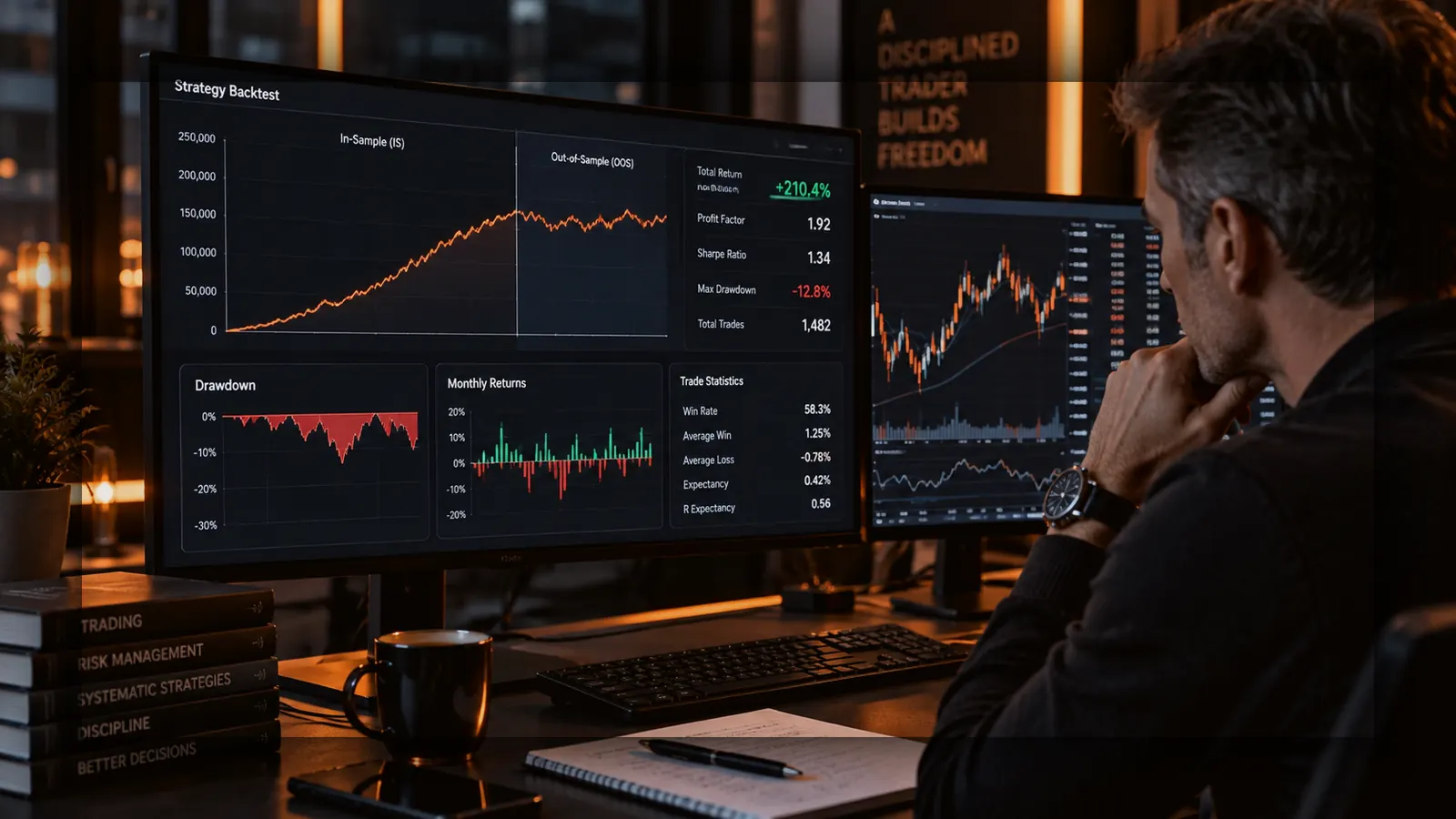
A clean, high-Profit-Factor backtest is genuinely meaningful evidence. It is also not proof that a strategy will trade well going forward. Treating a backtest as a verdict rather than as evidence is one of the more expensive habits in systematic trading — not because backtests are worthless, but because a single historical result carries more uncertainty than the headline numbers usually suggest.
A backtest is one realised path through history
A backtest describes what happened, once, over one specific historical window. The market didn’t have to move exactly that way — it could plausibly have taken any number of similar-but-different paths, with different news, different volatility, different sequencing of winning and losing trades. The result you see is one draw from a much wider range of things that could reasonably have happened. Monte Carlo Testing Explained looks at one way of exploring that wider range rather than trusting the single realised path alone.
Sampling and favourable regimes
Every backtest covers a finite window of history, and that window inevitably contains whatever market regimes happened to occur during it. A strategy tested mostly across a strong trending period, for instance, may never have been meaningfully challenged by a prolonged range — not because the strategy handles ranges well, but because the test period didn’t include much of one. The backtest isn’t wrong; it’s simply silent about conditions it didn’t encounter.
Execution assumptions
Backtests rely on assumptions about spread, slippage, and fill behaviour that are approximations of live execution, not guarantees of it. A strategy with a thin per-trade edge can be more sensitive to these assumptions than its headline Profit Factor suggests — small, realistic differences in execution cost can matter more for a high-frequency, low-edge-per-trade system than for one with fewer, larger-edge trades.
Limited trades and hindsight
A strategy with a modest number of historical trades carries more statistical uncertainty than one with a large sample, even if both show a similar Profit Factor — see Profit Factor, Expectancy, Stability and Trade Count for why trade count belongs in the same conversation as the headline metrics. And it’s worth being honest about hindsight: it is far easier to build confidence in a rule set after seeing how the market actually behaved than it would have been to specify that same rule set in advance, without knowing the outcome. Backtesting inevitably involves working backward from known history to some degree — the question is how much, and that is exactly what Over-Optimisation and Curve Fitting addresses directly.
Parameter sensitivity
A strategy whose performance changes dramatically with small parameter adjustments is telling you something important: its historical result may depend heavily on the exact values chosen, rather than on a genuinely robust underlying pattern. A strategy that performs reasonably across a range of nearby parameter values is generally more reassuring than one that only performs well at a single, precisely tuned setting.
Why live differs from backtest, even for a genuinely sound strategy
Even a well-built, honestly tested strategy is not guaranteed to replicate its backtest live, because live trading introduces real-world execution, evolving market conditions, and a forward-only sample the backtest never had to prove itself against. This isn’t a flaw specific to any one strategy — it’s the nature of the difference between simulation and live experience, covered in more detail in Backtest vs Live Trading.
What this means in practice — evidence, not proof
None of this means a good backtest is meaningless. A clean historical result across a reasonable sample, with sensible parameter stability and honest execution assumptions, is real, useful evidence that a strategy’s logic has some merit. The right posture is simply to treat it as one important piece of evidence among several — sample size, parameter stability, out-of-sample behaviour, robustness testing, and eventually live monitoring — rather than as a single number that settles the question on its own.
Where this fits in the SIPS workflow
Strategy Performance presents a strategy’s full backtest detail, including its FULL/IS/OOS sample split where available, precisely so a single headline metric isn’t the only evidence in view. Strategy Metrics Explained covers what each of those measures actually means.
The practical takeaway
A great backtest earns a strategy the right to be considered further — it doesn’t earn it a guarantee. Read it alongside sample size, parameter sensitivity, and out-of-sample evidence, and keep watching once the strategy is live, because a backtest is the beginning of the evidence, not the end of it.